
Pennsylvania's Split Clerk Structure
Pennsylvania does not use one county clerk for every court file. Northampton County splits the job across three offices. Each office keeps a different slice of the record. That setup trips up a lot of people, so it helps to learn it early. The trial court itself is the Court of Common Pleas, part of the Third Judicial District, and below it sit fifteen Magisterial District Courts.
Here is the short version. Criminal Common Pleas files go to the Criminal Division, which acts as the Clerk of Courts. Civil and family files, like divorce and custody, go to the Prothonotary. Wills, estates, guardianship, and marriage records go to the Register of Wills and Orphans' Court. Send a request to the wrong office and it gets bounced or delayed, and a clerk then has to point you elsewhere.
- Clerk of Courts (Criminal Division)
- Custodian of Common Pleas criminal records, costs, fines, and bail.
- Prothonotary (Civil Division)
- Civil and family papers, including divorce, custody, judgments, and liens.
- Register of Wills and Orphans' Court
- Decedent estates, guardianship, adoption dockets, and marriage records.
Note: A docket sheet may name all three offices, but copies of a file come only from the office that holds that case type.
The Criminal Division as Clerk of Courts
The Criminal Division serves as the Clerk of Courts for Northampton County. Its stated mission is to keep accurate criminal records for the court and the people of the county. That makes it the custodian of every Common Pleas criminal file, from a low-grade misdemeanor up to a serious felony. The office also takes court costs and fines on those cases, and it handles bail during business hours. It sits inside the Government Center in Easton, the same building that holds the other court offices.
One firm rule matters before you call. The office will not give disposition or sentencing information over the phone. To learn how a case ended, you read the docket or get a record search. Phone staff can route you, but they will not read out an outcome. For questions about hearing dates, scheduling, or restitution, the county sends you to the District Attorney instead.
Clerk of Courts / Criminal Division
Northampton County Government Center
669 Washington Street
Easton, PA 18042
DA scheduling/restitution: 610-829-6666
Hours: Mon-Fri 8:30 a.m. to 4:30 p.m.
The office's full duties, payment rules, and bail steps are posted on the official Northampton County Criminal Division page. That page is the best source for any change in hours or fees. For broad case history across all divisions, see the Northampton County court records guide.
Northampton County Criminal Record Search
Most searches start online and end at this office. The free first stop is the statewide Pennsylvania UJS Case Search, which posts Common Pleas criminal docket sheets and magisterial dockets. Set the county to Northampton, then search by name, docket number, OTN, complaint number, or citation number. A docket sheet shows charges, events, bail, and the disposition. It is a summary, though, not the full file.
For a paper or certified record, you turn to the Clerk of Courts. The office runs a Northampton County Common Pleas criminal record search for a $10.00 fee. You can ask in person or by mail. Copy and certification fees may add to that base cost. Keep in mind that a county docket search is not an official criminal-history check. Only the Pennsylvania State Police can produce that for jobs or licensing.
- Search the UJS portal first and note the docket number, defendant name, and date of birth.
- Pick your method: visit the Criminal Division in person, or send a mail request.
- For mail, write a request that lists the defendant's name, date of birth, and case number if you know it.
- Include payment of the $10.00 search fee, plus any copy or certification fees.
- Make a mail payment by business check, certified check, or money order payable to "Criminal Division."
- Mail the request and payment to the Government Center, or hand it in at the office during business hours.
Do not expect a result over the phone. The office will confirm how to file the request, but the record itself comes back by mail or at the counter. If you only need to track events on an open case, the free UJS docket is often enough.
Payment Methods and Fees
The Criminal Division is strict about how it takes money, and the rules differ by channel. In person, you can pay with cash, credit card, money order, or certified check, and the office takes Visa, MasterCard, and Discover. By mail, the office wants a business check, certified check, or money order made out to "Criminal Division." It does not take personal checks at all. Do not mail cash, and do not try to give a card number over the phone, since the office will not record card details that way.
Online payment runs through PAePay on the UJS portal with Visa, MasterCard, or Discover. The county notes a $2.75 transaction fee for that route. Bail is its own case, covered below, and it takes only cash or certified check. The table sums up the main charges tied to a Northampton County criminal records request.
| Service | Amount |
|---|---|
| Common Pleas criminal record search | $10.00 |
| Online cost payment transaction fee (PAePay/UJS) | $2.75 per transaction |
| Bail payment (cash or certified check only) | Set per case |
| Copy and certification fees | Added when they apply |
Always include the defendant's name and date of birth on a mailed payment so staff can match it to the right file. A case number helps too. Without those details, a check can sit unmatched.
Posting Bail in Northampton County
Bail rules here are tight, and timing decides where you go. During regular business hours, you post bail at the Criminal Division. The county asks one thing first: contact Pre-Trial Services before you come, so staff can confirm the case and the amount. The office is closed on holidays. After hours, bail does not stop, but the place changes.
Outside business hours, bail is posted at Northampton County Prison instead of the Government Center. Either way, the payment rule is the same. Only cash or a certified check is accepted for bail. A personal check, a card, or a regular money order will not work for bail. Bring the exact set form of payment to avoid a wasted trip.
Important: Call Pre-Trial Services before posting bail at the Criminal Division, and bring only cash or a certified check, since no other form is accepted for bail.
Arrests, booking, and the first court events feed into all of this. To track a defendant in custody and the bail status, the Northampton County arrest records page lists the booking and jail contacts.
Traffic, Bench Warrants, and Hearing Questions
Not every question belongs to the Clerk of Courts, and calling the wrong line wastes time. Traffic tickets are a good example. The Criminal Division does not handle ticket payment questions. Those go to the Magisterial District Court or the police agency that wrote the citation. Most traffic and summary matters live in the district courts, and they show up on UJS under a citation number.
Bench warrants are another split. For a bench warrant question, the county points you to the Northampton County Sheriff's Office, not the Clerk of Courts. Hearing dates, scheduling, and restitution claims go to the District Attorney. The routing table below sorts the most common needs to the right phone line or office.
| What You Need | Where to Go |
|---|---|
| Criminal record search or copy | Criminal Division / Clerk of Courts |
| Traffic ticket or citation payment | Issuing Magisterial District Court or police agency |
| Bench warrant question | Sheriff's Office, 610-829-6561 |
| Hearing date, scheduling, restitution | District Attorney, 610-829-6666 |
| Adult Probation | 610-559-6800 |
| DUI Probation / ARD | 610-559-6810 |
The District Attorney's Office also posts arraignment and trial lists, which help confirm a court date. To read what each docket field means, the Northampton County court dockets page breaks it down. Arrest and charge detail sits on the arrest records page.
Treatment Courts in Northampton County
Northampton County runs three problem-solving courts that sit alongside the standard criminal docket. These are Mental Health Court, Recovery Court, and Veterans' Court. Each one pairs court supervision with treatment instead of a plain prison track. They are not a promise of dismissal. A participant follows a treatment plan, attends review hearings, and faces sanctions or incentives based on progress.
The programs serve different needs. Mental Health Court is for people whose mental health needs feed into their criminal case. Recovery Court targets substance-use-driven cases and adds drug and alcohol testing with probation supervision. Veterans' Court serves eligible veterans whose service-related issues, such as trauma or substance use, tie into their charges. Each track has its own application and policy manual.
The county posts the applications and program manuals for all three tracks on the official Northampton County Treatment Courts page.
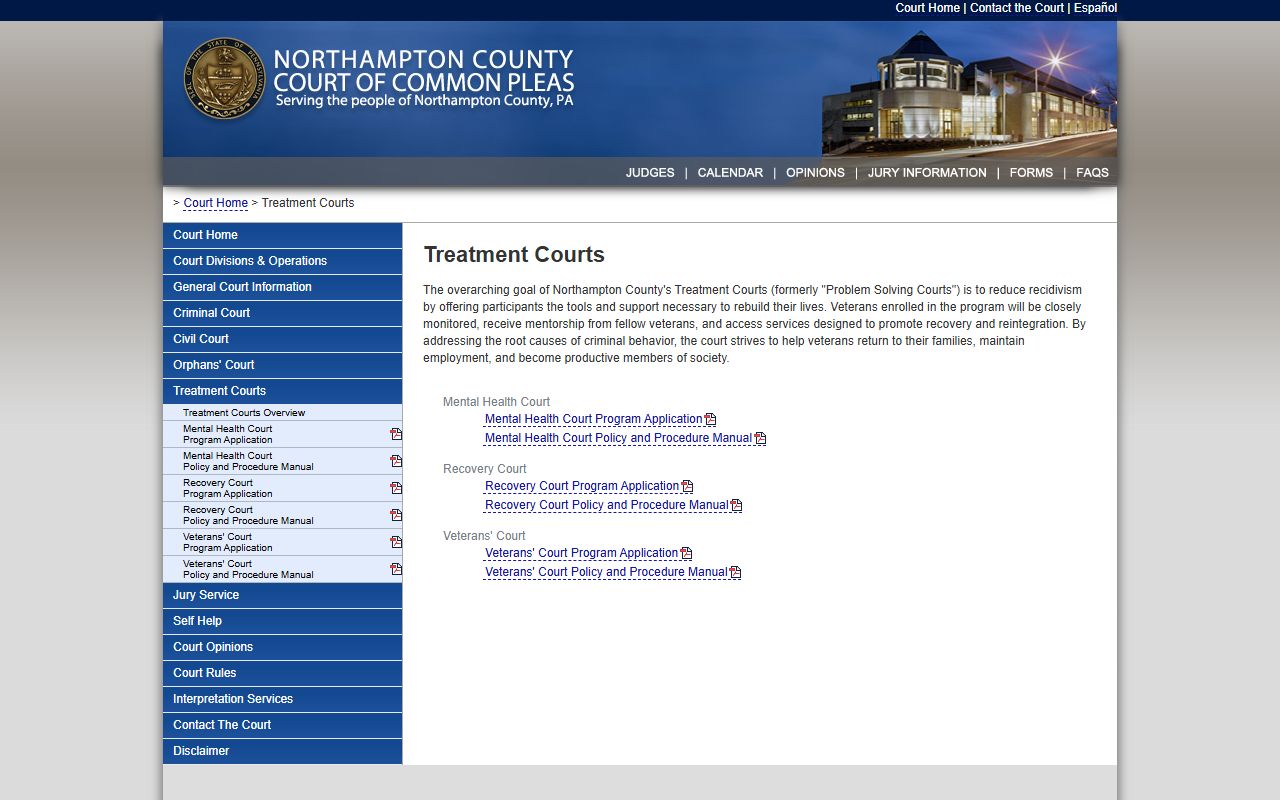
That page links the application and policy manual for each court, so check it before you ask the Clerk of Courts about a referral. A related track, DUI ARD, is a pre-trial diversion for first-time DUI cases that starts with screening by the District Attorney.
Courtroom Rules and Electronics
A trip to the Clerk of Courts means a trip into the Government Center, and the building has rules. Every visitor enters through the first-floor main entrance and passes electronic screening. Security officers may check your belongings. The Sheriff's staff screens for weapons and other prohibited items. Plan extra time for the Washington Street hill, parking, and that screening line before you reach the office.
Phones and recording are a separate matter. The court keeps a "Use of Electronics" policy because rules can shift by judge, hearing type, and security status. Never record, photograph, or livestream a proceeding unless the court clearly allows it. When in doubt, follow courtroom staff instructions and silence your phone.
The official Northampton County court electronics policy spells out the current rules for cell phones and recording.
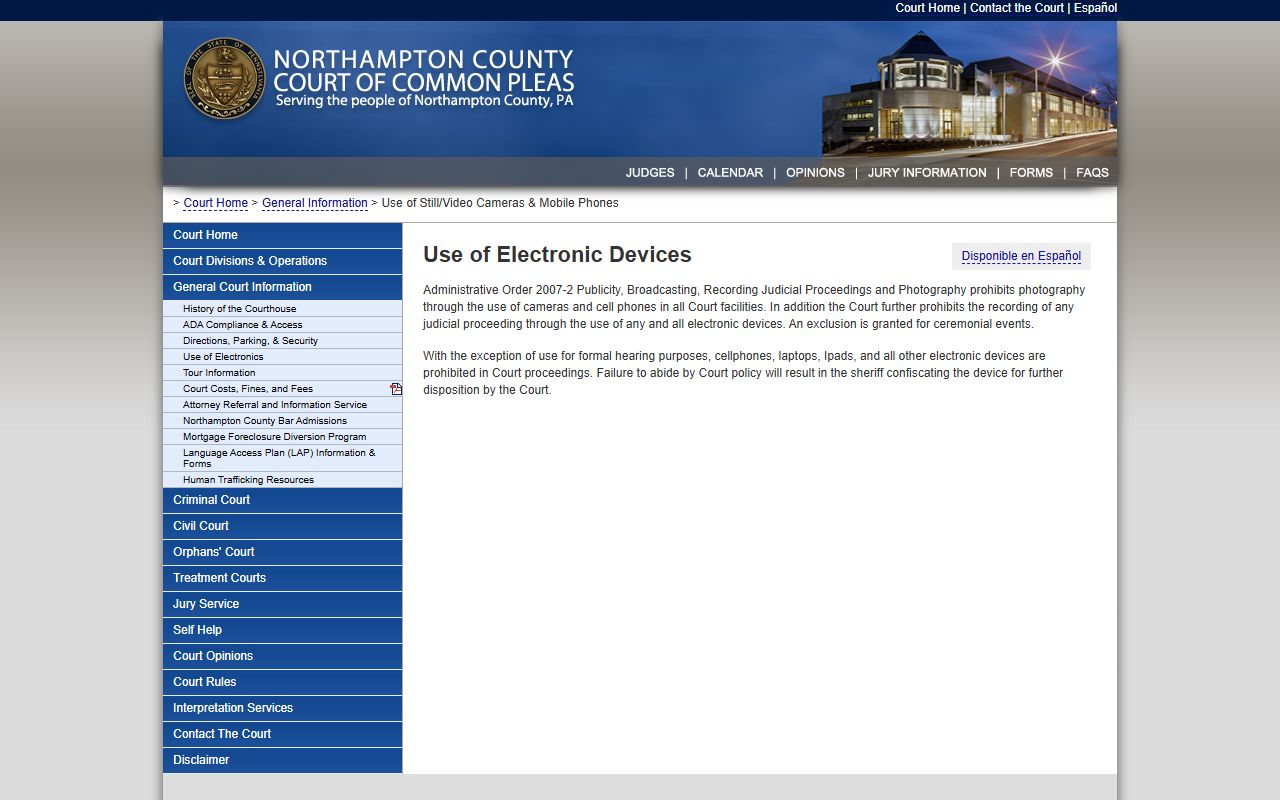
The policy page is the place to confirm what you can carry into a courtroom and how to ask about recording. Checking it first saves a problem at the door.