
Pennsylvania's Split Clerk Structure
Pennsylvania does not use one county clerk for every court file. Northampton County splits court-record custody across three offices, and each holds a different slice of the record. The Prothonotary, also called the Civil Division, keeps civil filings. The Criminal Division acts as the Clerk of Courts for criminal cases. The Register of Wills and Orphans' Court keeps estate, guardianship, adoption, and marriage records. Matching a case to the right office saves time and avoids a wasted trip.
The split matters most when you request a copy. A divorce decree or a judgment comes from the Prothonotary. A criminal docket copy comes from the Criminal Division. A will or a marriage license comes from the Register of Wills. All three sit in the same Government Center in Easton, but they are run as separate offices with separate records.
Estate and marriage questions go to the Register of Wills and Orphans' Court office. You can see that office's contact details on the Register of Wills and Orphans' Court contact page.
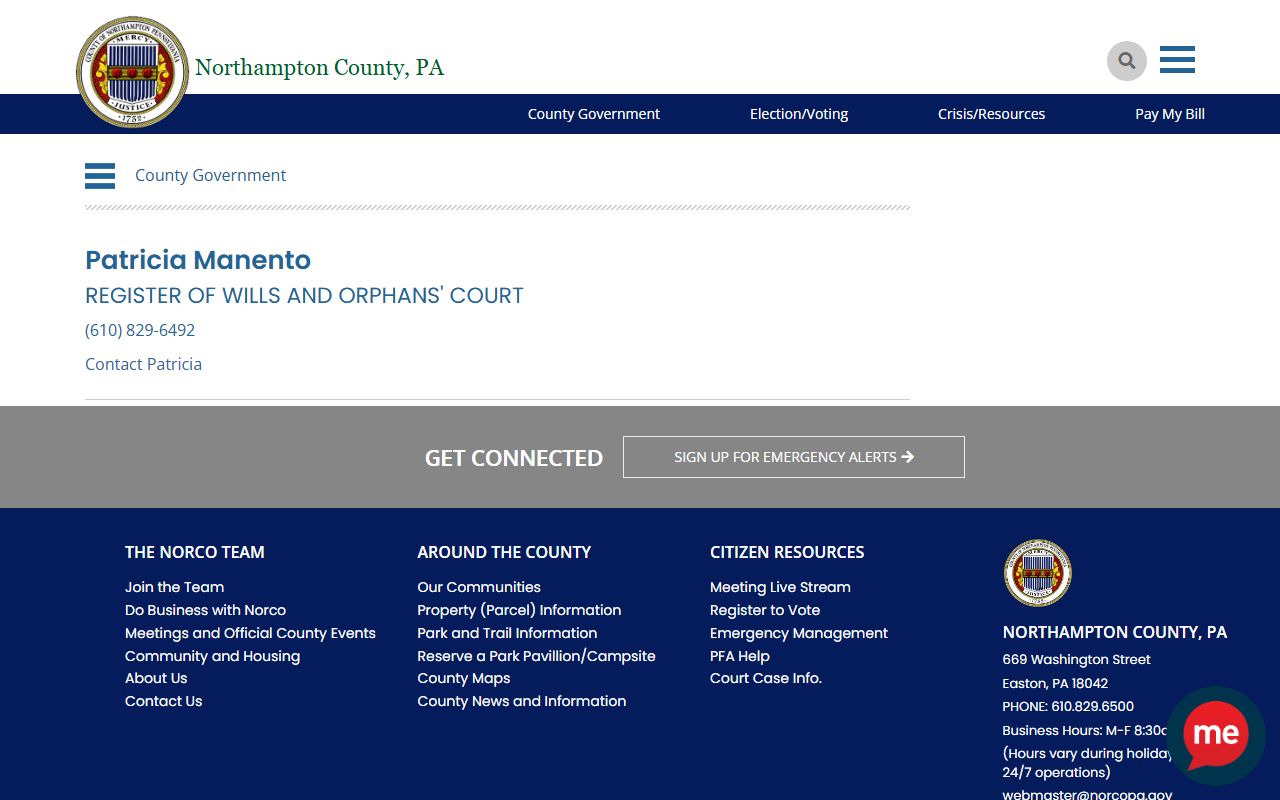
That page confirms estate and Orphans' Court matters are not handled by the Prothonotary, which keeps the civil records covered here. For estate filings, use the Orphans' Court page instead.
- Prothonotary
- The civil filing office of the Court of Common Pleas. Keeps divorce, custody, judgments, liens, and name changes.
- Clerk of Courts
- The Criminal Division. Custodian of Common Pleas criminal records and the office that takes criminal payments.
- Register of Wills
- The office for decedent estates, Orphans' Court filings, guardianship, adoption, and marriage records.
The Northampton County Prothonotary Civil Division
The Prothonotary / Civil Division records and files civil legal papers for the county. Its job is to log each filing, keep the official civil record, and route documents to the court. The office sits inside the Northampton County Government Center in downtown Easton. Public counter hours run weekdays, and the office shares the building with the other court divisions.
Civil cases here come from the Court of Common Pleas, the trial court for the Third Judicial District. The Prothonotary does not handle criminal matters or estates. For criminal filings and payments, see the Clerk of Courts page. For the broader court system and how cases move through it, the Court of Common Pleas page lays out the structure.
Prothonotary / Civil Division
Northampton County Government Center
669 Washington Street
Easton, PA 18042
610-829-6500
Monday to Friday, 8:30 a.m. to 4:30 p.m.
Note: The Prothonotary, the Criminal Division, and the Register of Wills share one address but keep separate records, so name the division when you call or write.
CountySuite Civil Case Search
Common Pleas civil cases need their own search tool. The Northampton County CountySuite Civil Case Search is the Prothonotary Online Portal. It carries the banner "Northampton County Prothonotary Online Portal" and covers divorce, custody, judgments, liens, mortgage foreclosure, personal injury, and name change cases. The portal is free to view, and it also supports e-filing. A Help menu links a Case Search User Guide and filing guides.
Why the separate tool? The statewide UJS portal posts criminal and magisterial dockets, but its own help pages confirm Common Pleas civil docket sheets are not public on UJS. So for civil cases you use CountySuite, not the state site. For criminal or traffic dockets, start with the UJS search described on the court records page.
The portal runs as a browser app, and the search form loads when the page opens. The table below shows the search features the portal exposes through its menus and purpose.
| Feature | What It Does |
|---|---|
| Case Search | Looks up civil Common Pleas cases by case number or party name. |
| Case Search User Guide | Help-menu PDF that walks through search steps and filters. |
| Filing PDF Upload Guidance | Help-menu guide for preparing documents for e-filing. |
| Filing User Guide | Step instructions for submitting a civil filing online. |
| Register User Guide | Account setup help for new e-filing users. |
Civil Records the Northampton County Prothonotary Keeps
The civil side of the court covers a wide range of papers. The Prothonotary lists the filing types it records on its own page, and the list runs from family matters to money disputes. Some filings start a brand-new case. Others, like an appeal from a district court judgment, move a case up from a lower court. Each one becomes part of the civil record once it is logged.
- Family - divorce, custody, and Protection from Abuse (PFA) filings.
- Money disputes - judgments, personal injury, and medical malpractice cases.
- Property and debt - mortgage foreclosure, mechanics liens, and federal tax liens.
- Appeals - District Justice (MDJ) appeals and driver's license suspension appeals.
- Other civil - change of name petitions and related civil papers.
A few of these carry special steps. Custody actions must clear Motions Court before they can be filed. Mortgage foreclosure filings must follow the county's Mortgage Foreclosure Diversion Program, which has its own administrative order and forms. PFA filing goes through the court, and the Sheriff handles service of those orders. Divorce and name change cases also have self-help paths through the county court site.
Note: A custody order must be signed in Motions Court, held weekdays at 9:00 a.m. in Courtroom 4, before it can be filed with the Prothonotary.
E-Filing and Fees for Northampton County Civil Records
E-filing is live for civil cases. The Prothonotary page links an e-file option along with best-practice guidance, including an "E-Filing Upload Guidance" note and a tip sheet on interactive PDF fields. Filers prepare documents, upload them through the CountySuite portal, and pay the filing fee online. The portal's help guides walk through account setup and document upload for first-time users.
Fees vary by filing type. The Civil Division publishes a fee schedule, and the office links a current Northampton County Civil Division/Prothonotary Fee Schedule on its page. Exact amounts come from that schedule, so check it before you file. One charge is fixed: online payments add a transaction fee. The table below sums up the fee picture.
| Item | Fee |
|---|---|
| Civil filing fees | Per the published Civil Division / Prothonotary fee schedule |
| Online payment transaction | $2.75 per transaction |
| Certified copies | Per the published fee schedule |
No-fault divorce packets are free to pick up. The county keeps the paperwork and instruction packets in the Courthouse Law Library, on the first floor near the Juror's Lounge. The same forms appear on the county court site. For marriage and divorce record copies after a case closes, the marriage and divorce records page explains where each file lives.
Requesting a Certified Copy
Viewing a civil docket is one thing. Getting an official copy is another. A certified copy carries the court's seal and is the version courts and agencies accept. For civil, divorce, custody, judgment, and lien records, the request goes to the Prothonotary, since it holds those files. Plain copies cost less than certified copies, and fees follow the published schedule.
- Confirm the case is civil and find the docket number through the CountySuite portal.
- Note which document you need, such as a divorce decree, judgment, or a full case file.
- Contact the Prothonotary at the Government Center to confirm the copy and certification fee.
- Submit the request in person or by mail with the case details and payment.
- Pick up the certified copy or wait for it to arrive by mail.
Keep the records split in mind when you order. A criminal record copy is not a Prothonotary job; that request routes to the Criminal Division. The county charges a set fee for a Common Pleas criminal record search, and you can read more on the Clerk of Courts page. Estate and marriage copies come from the Register of Wills.
Visiting the Northampton County Prothonotary Office
The Prothonotary sits in the Northampton County Government Center at 669 Washington Street in downtown Easton. The building also houses the courtrooms, the Criminal Division, and the Register of Wills. All visitors enter through the first-floor main entrance for electronic screening, and security staff may check belongings. Parking is in the adjoining structure, which fills fast on jury weeks.
The courthouse has a long history. You can read it on the courthouse history page, which traces the building from its first opening to a major 2004 expansion.
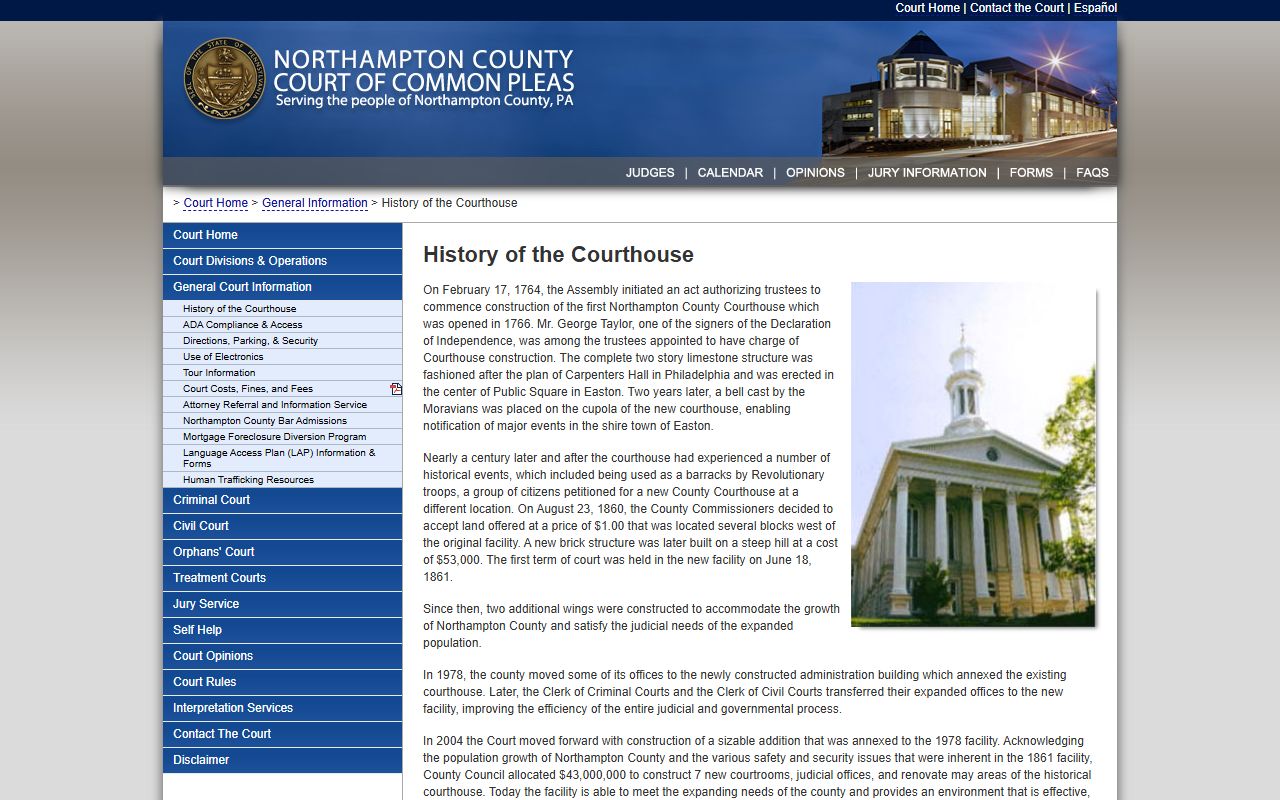
That history page helps explain why the civil offices and courtrooms now share one large Government Center complex.
The court works to keep the building open to everyone. People who need special help may use the basement entrance. The ADA Compliance and Access page explains how to ask for an accommodation.
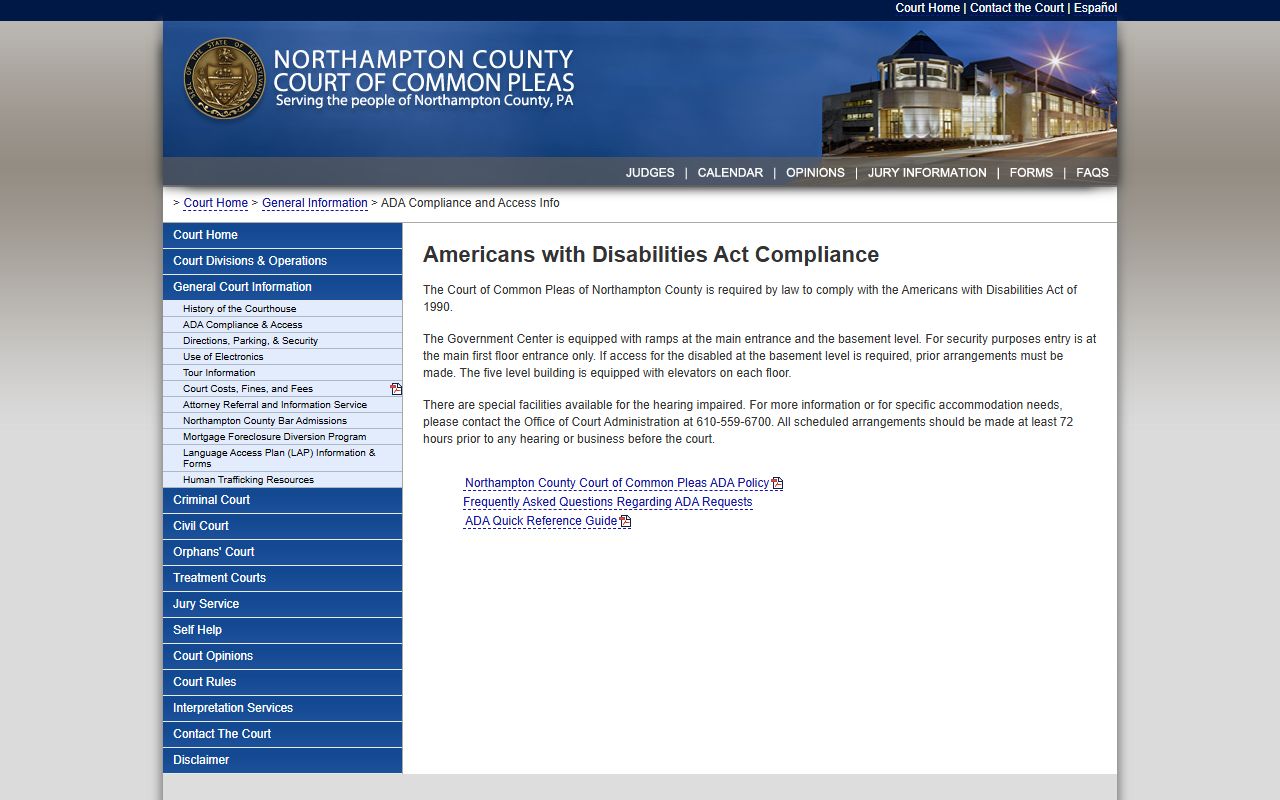
That page lets civil filers request access help before a courthouse visit or a filing deadline.
Language help is free. The court's Language Access Plan states that parties have the right to an interpreter at no cost.
That plan means a language barrier should not block a civil filing or a hearing in the county.
Forms and Self-Help for Civil Filings
Most civil cases start with the right form. The county keeps a forms library with civil, divorce, domestic relations, and other filing documents ready to download. The Prothonotary page itself links several specific forms, such as the PA Civil Court Coversheet, the Notice of Appeal from a Magisterial District Judge Judgment, and tenant supersedeas forms for appeals. Pulling the correct form first cuts down on rejected filings.
Self-help paths exist for common needs. The county has divorce, name change, and expungement self-help pages that walk through the steps and link the forms. Custody filings have their own route: new custody actions and modification or contempt forms come through the court system, and the completed paperwork must be signed in Motions Court before it reaches the Prothonotary.
Start your search in the Northampton County court forms library, which groups forms by court administration, civil, criminal, divorce, domestic relations, DUI, and juvenile categories.
Note: No-fault divorce instruction packets are kept in the Courthouse Law Library on the first floor near the Juror's Lounge, in addition to the online forms.